7 Signs Your Gut Health Might Be Off


A bloated stomach after a heavy dinner rarely raises questions. Bloating that shows up most afternoons, a bathroom routine that has quietly stopped being predictable, or tiredness that sleep doesn’t fix is different, and it is often the point at which people start looking into poor gut health symptoms.
The difficulty is that these symptoms aren’t specific. The same bloating can come from a big meal, stress, a medication, or a digestive condition, and only some cases involve the gut microbiome at all.
What Is Poor Gut Health, Exactly?
Poor gut health is a wellness term, not a medical diagnosis. People often use it to describe recurring digestive symptoms or concerns about the gut microbiome, although the two are not necessarily the same thing. The gut microbiome is the community of bacteria and other microbes that lives mostly in the large intestine and helps break down certain components of food. Changes in the composition or function of this microbial community are sometimes described as dysbiosis, but there is no single microbiome profile that defines an ‘unhealthy’ gut.
Symptoms alone can’t show whether the microbiome is involved. Someone with unhealthy gut symptoms might have a microbiome imbalance, a food intolerance, a functional condition such as irritable bowel syndrome, or something else entirely. That leaves a practical question: what are the signs of bad gut health that are worth paying attention to?

Signs and Symptoms of Poor Gut Health
Poor gut health rarely shows up as one dramatic complaint. More often, people notice recurring digestive changes, sometimes alongside differences in sleep, energy, or mood. Skin flare-ups, frequent infections, and sugar cravings are often mentioned online, but they have many other explanations and a weaker case for a gut link, so they’re left out here. Treat the list as things worth noticing, not as a self-diagnosis checklist.
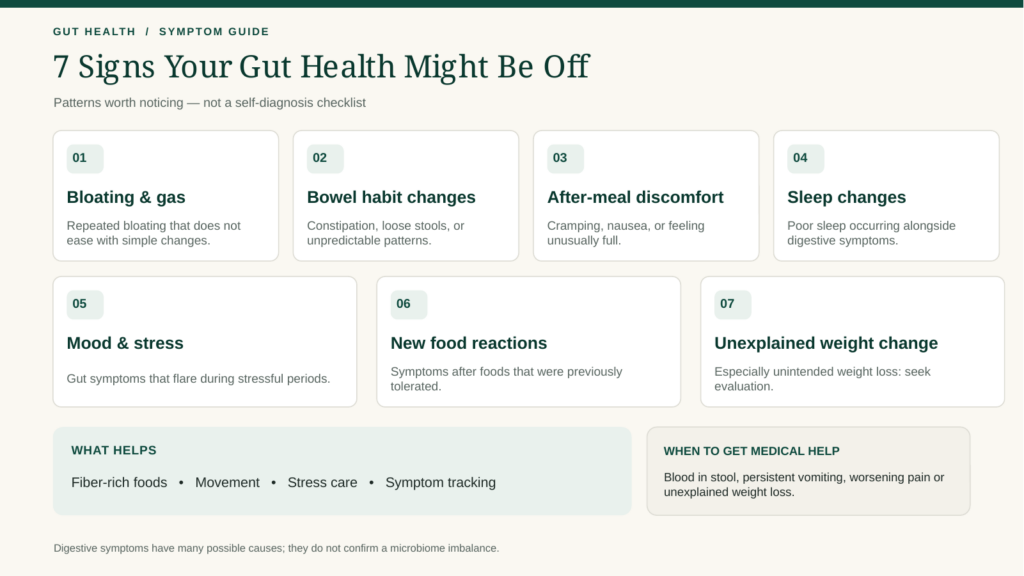
1. Bloating and gas that keep coming back
A little bloating after a large or high-fiber meal is normal. It deserves attention when it shows up regularly and doesn’t ease with simple diet changes. Gut bacteria produce gases as they ferment certain carbohydrates, so the microbiome can influence gas production. That does not mean recurring bloating automatically points to a microbiome problem. Food intolerances, constipation, and swallowed air can feel identical, though.
2. Bowel habits that swing or stall
Constipation, loose stools, or a pattern that alternates between the two are among the most recognized poor gut health signs. Fiber, fluids, movement, stress, and medications all affect how quickly food moves through the intestines, so a persistent or unexplained change is worth paying attention to, even if it doesn’t reveal the cause.
3. Discomfort after eating
Cramping, nausea, or a heavy, overfull feeling after meals can reflect slow digestion or a more sensitive gut. Heartburn is often listed here too, but it mainly involves the upper digestive tract and has many causes. If heartburn is frequent, persistent, or requires regular use of antacids, it is worth discussing with a healthcare professional rather than assuming the gut microbiome is responsible.
4. Poor sleep that appears alongside digestive changes
The relationship between sleep and the gut microbiome is still being investigated. A 2026 study of 6,941 Dutch adults found that lower gut microbial diversity was associated with poorer sleep quality, but the study did not establish that microbiome changes caused sleep problems.
5. Mood and stress changes that travel with gut symptoms
The gut and brain communicate through neural, hormonal, and immune pathways, which is why stress and digestive symptoms can influence each other. Stress can change how the gut moves and how sensitive it feels, while ongoing digestive symptoms can weigh on mood. If your stomach reliably acts up in stressful weeks, that pattern is worth noting.
6. Food reactions that seem new
Reacting to foods you used to tolerate can reflect an intolerance, a stomach infection, or a recent course of antibiotics rather than a lasting microbiome problem. A food and symptom diary can help reveal patterns and gives you something concrete to discuss with a healthcare professional.
7. Weight changes you can’t explain
Unexplained weight change is sometimes grouped with ‘gut health’ symptoms online, but it should not be treated as evidence of a microbiome problem. Unintentional weight loss in particular warrants medical evaluation rather than self-experimenting, especially when it appears alongside digestive symptoms.
How Can You Tell If You Have Bad Gut Health?
You can’t tell from a single symptom. What does bad gut health look like in practice? A pattern: how long a symptom has lasted, whether it repeats at certain times or after certain foods, and whether several signs appear together. Keeping notes for a week or two on meals, bowel movements, sleep, stress, and symptoms can make patterns easier to spot. From there, a healthcare professional can rule out conditions such as celiac disease, inflammatory bowel disease, or infection, none of which a supplement should be expected to address.
How Closely Should You Track Your Gut Symptoms?
Answer five quick questions about the patterns you have noticed lately. This quiz cannot diagnose an unhealthy microbiome or digestive condition.
Everyday Habits That Give Your Gut a Steadier Footing
For many people, getting enough dietary fiber is a practical place to start. Common U.S. fiber recommendations fall around 25–38 grams per day for many adults, although individual needs vary by age, sex, and energy intake. Gut bacteria ferment certain types of fiber and produce short-chain fatty acids, compounds that play a role in maintaining the health of the colon. Beans, oats, vegetables, fruit, nuts, and seeds are practical sources; add them gradually and drink enough water so digestion can adjust.
Fiber isn’t the only lever. Regular exercise helps keep food moving through the intestines, and managing stress matters because the gut and brain influence each other. Fermented foods such as yogurt with live cultures, kefir, kimchi, or sauerkraut can also add variety to the diet, although their effects on the gut microbiome can differ by food and by individual.
Once diet, fiber, movement, and other basics are in place, some people also consider probiotics for gut health as part of their routine. Evidence for probiotics is specific to the strain, dose, and outcome studied, so results for one product do not automatically apply to another. Probiotics should be considered alongside, rather than as a replacement for, everyday dietary and lifestyle habits.
Bioma Probiotics contains three Bifidobacterium strains: B. breve, B. longum, and B. lactis. It also contains xylooligosaccharides (XOS), a prebiotic ingredient that has been studied for its effects on Bifidobacteria, and tributyrin, a butyrate-releasing compound. Those studies evaluate individual ingredients or probiotics more broadly, not the Bioma formula itself, so they cannot show that this product will relieve the symptoms discussed here. The directions are two tablets daily with water, and the formula is vegan. People with underlying health conditions, a weakened immune system, or concerns about supplement–medication interactions should discuss probiotic use with a healthcare professional.

When Symptoms Are Worth a Doctor’s Visit
What are the symptoms of bad gut health that shouldn’t wait? Blood in the stool, unintentional weight loss, persistent vomiting, difficulty swallowing, anemia, worsening abdominal pain, or a marked change in bowel habits all warrant medical evaluation, especially when there is a family history of gastrointestinal cancers. New or persistent digestive symptoms later in life may also deserve a closer look. Black or tarry stools, or vomit containing blood, need urgent medical attention.
If none of those warning signs apply but symptoms keep returning, track what is happening before changing several things at once. That makes it easier to see whether changes in food, sleep, stress, or bowel habits actually line up with your symptoms. If you do see a healthcare professional, bringing those notes can give them a clearer picture of when symptoms occur and what may be associated with them.
Sources
- Cleveland Clinic. Disorders of Gut-Brain Interaction (Functional Gastrointestinal Disorders). https://my.clevelandclinic.org/health/diseases/disorders-of-gut-brain-interaction-dgbi
- INTEGRIS Health. Gut Health Red Flags: When to Seek Help. https://integrishealth.org/resources/on-your-health/2025/september/gut-health-red-flags
- NIDDK. Symptoms & Causes of GI Bleeding. https://www.niddk.nih.gov/health-information/digestive-diseases/gastrointestinal-bleeding/symptoms-causes
- Nature Communications. The interplay of sleep characteristics with health factors and gut microbiome. https://www.nature.com/articles/s41467-026-68791-9
- Dartmouth Health. How Much Fiber Do You Need? https://www.dartmouth-health.org/articles/how-much-fiber-do-you-need
- Houston Methodist. Gut Health: Signs of an Unhealthy Gut & How to Improve It. https://www.houstonmethodist.org/blog/articles/2025/apr/gut-health-signs-of-an-unhealthy-gut-how-to-improve-it/
- Torrance Memorial. Feeding Your Gut: Why Fiber Matters for Your Microbiome. https://www.torrancememorial.org/healthy-living/blog/why-fiber-matters-for-your-gut-microbiome/
- PubMed. Xylooligosaccharide increases bifidobacteria but not lactobacilli in human gut microbiota. https://pubmed.ncbi.nlm.nih.gov/24513849/
- PubMed. Tributyrin, a stable and rapidly absorbed prodrug of butyric acid. https://pubmed.ncbi.nlm.nih.gov/11385076/
Related articles



Less gut discomfort. More freedom to enjoy life.
Take our 1-min quiz to find out your gut type and get personalized advice and probiotics to relieve constipation, bloating, and other digestive issues.


