Could Your Gut Be Making Menopause Symptoms Feel Worse?


Hot flashes, poor sleep, and mood changes get most of the attention in menopause. Less often discussed are the digestive changes many women notice at the same time: bloating, constipation, and a stomach that seems to react to everything. That raises a fair question about whether the gut is simply along for the ride or is making other symptoms feel worse.
The short answer is that gut health and menopause are connected, but the evidence is still early. Research shows clear links between hormones, digestion, and the gut microbiome, while stopping short of proving that the gut drives menopause symptoms.
Can Menopause Cause Stomach Issues?
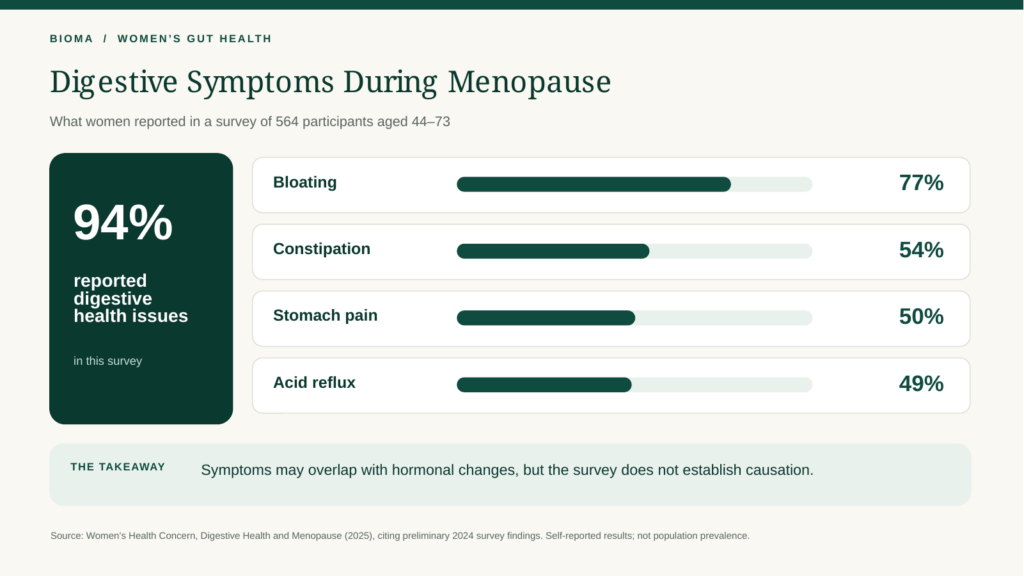
Digestive changes are commonly reported during menopause. Preliminary findings from a 2024 survey of 564 women aged 44 to 73, cited by Women’s Health Concern, found that 94% reported digestive health issues during menopause. The survey cannot prove that menopause caused those symptoms, but it does show that digestive complaints frequently occur during this stage of life.
The pattern is broad. Bloating was the most common complaint at 77 percent, followed by constipation (54 percent), stomach pain (50 percent), and acid reflux (49 percent). The changes can involve different parts of the digestive system. Some women report reflux or stomach pain, while others mainly notice bloating, constipation, or changes in bowel habits. Women’s Health Concern notes that falling estrogen and progesterone may influence gut motility, the gut–brain axis, and the gut microbiome, although further research is needed to establish a clear link between hormonal changes and digestive symptoms.
Can Menopause Affect Gut Health?
Possibly, though researchers choose their words carefully. A 2025 review in Post Reproductive Health concludes that declining estrogen appears to influence the gut microbiota, while noting that most studies are observational and that age-related changes need to be separated from menopause-specific ones. A 2026 review in Nutrients describes reduced gut microbiome diversity as one pattern reported across menopause research, while also emphasizing substantial differences between populations and the limited number of studies able to establish cause and effect.
These digestive changes describe a real pattern, even if the mechanism is not yet settled. That is a reason for measured expectations, not for dismissing what women report.

Does Gut Health Affect Your Hormones?
There is a biological connection, although its clinical significance is still being studied. The term estrobolome refers to a collection of gut microbial genes involved in estrogen metabolism. Some of these genes encode β-glucuronidase enzymes, which can deconjugate estrogens that have been processed for excretion, allowing some of them to be reabsorbed into circulation. This is one way the gut microbiome may influence estrogen availability, which helps explain why gut health and menopause are increasingly studied together.
The Nutrients review reports associations between greater gut microbiome diversity and aspects of estrogen regulation, while also noting that no ideal microbial composition has been defined across the stages of perimenopause. The link is plausible and worth studying, but current microbiome testing cannot reliably determine how an individual’s gut microbiome is affecting their hormone levels or menopause symptoms.
Gut Health and Perimenopause: When Changes Can Start
Digestive changes don’t wait for the final period. In the Women’s Health Concern survey, 38 percent of women had digestive symptoms for the first time when perimenopause began. That timing is why gut health and perimenopause are discussed together, and it means symptoms can appear while periods are still happening.
New, persistent symptoms at this stage are worth mentioning to a doctor, since other conditions can look similar. Keeping a note of meals, sleep, and when symptoms appear gives that conversation something concrete to work with.

Could the Gut Make Other Menopause Symptoms Worse?
This is the part where the science is thinnest. A 2026 review in Proceedings of the Nutrition Society describes the gut–brain axis as a two-way communication network that may be influenced by hormonal changes during menopause. The authors discuss possible links between estrogen decline, gastrointestinal function, microbial composition, mood, cognition, inflammation, and stress, but much of the mechanistic evidence remains indirect. The same review notes that hot flashes and night sweats can impair sleep and worsen stress.
A cycle linking poor sleep, stress, and the gut is plausible, but the authors state that few studies have offered direct human evidence for it. So the honest answer to the title question is possibly, in some women, and not yet provable. Stress is one factor that can be addressed now. Women’s Health Concern lists yoga, breathing exercises, and mindfulness among strategies for managing it, and stress can worsen digestive symptoms in some people.
What Should You Pay Attention to During Menopause?
Digestive changes, stress, sleep, and everyday habits can overlap during menopause. Answer five quick questions to see which pattern may be most useful to track first.
Gut Health for Menopause: What May Help
Since gut health in menopause is shaped by several things at once, the practical steps are mostly familiar ones. Women’s Health Concern suggests eating regularly and chewing well, drinking enough water, adjusting fiber with a dietitian’s help, limiting personal triggers such as fatty foods, caffeine, alcohol, and spicy meals, and including plant-based and fermented foods. Gentle exercise such as walking, swimming, or yoga also features in that advice.
Eating pattern may matter too. The review cites observational evidence linking higher-quality carbohydrate intake — including more fiber and lower-glycemic foods — with lower menopausal symptom burden. Those findings do not prove that changing carbohydrate quality will reduce symptoms, but they fit with broader advice to prioritize plant-rich, fiber-containing foods and increase fiber gradually.
Gut Health Supplements for Menopause: What the Evidence Shows
Interest in gut health supplements for menopause has moved faster than the research. The Post Reproductive Health review states that evidence remains limited on underlying mechanisms and that most studies examine associations rather than cause. A systematic review and meta-analysis included six studies from five randomized controlled trials involving 281 postmenopausal women with overweight or obesity. It reported small improvements in insulin, insulin resistance, and TNF-α, an inflammatory marker, while changes in body adiposity and lipid measures were not statistically significant. Current evidence is therefore not strong enough to identify a best probiotic for menopause belly, bloating, or other menopause-related symptoms.
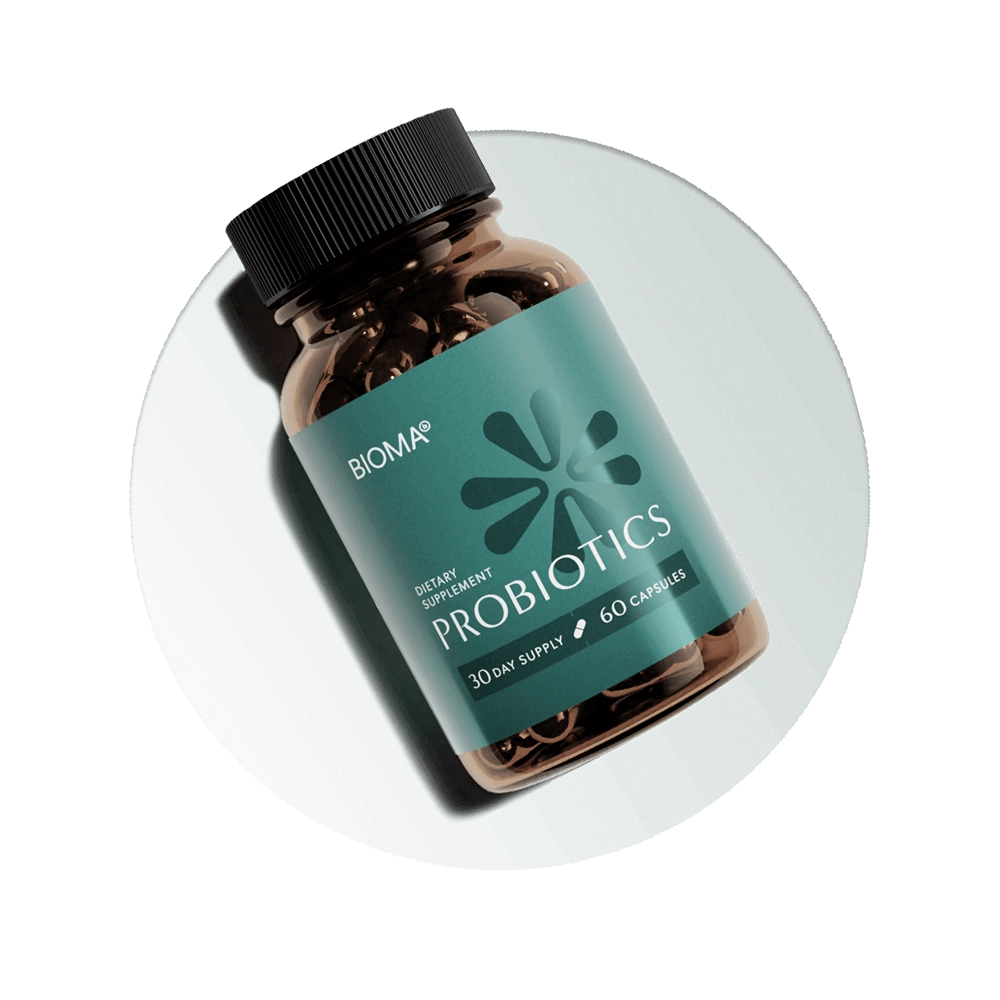
Effects also depend on the strain, according to the National Center for Complementary and Integrative Health, so results for one product do not automatically apply to another. For women who choose to try a probiotic for digestive symptoms, Women’s Health Concern advises following the manufacturer’s instructions, monitoring its effects for at least four weeks, and choosing a product recommended by a healthcare professional. Some women consider menopause probiotics as one part of that routine, alongside diet, movement, and sleep. Bioma’s menopause formula contains four Lactobacillus strains: L. plantarum, L. brevis, L. rhamnosus, and L. acidophilus. It also contains tributyrin, a butyrate-releasing compound. Research on probiotics as a category does not establish that this specific formula will ease bloating or other menopause symptoms. The directions are two capsules daily with water before breakfast. People with underlying health conditions, a weakened immune system, or concerns about supplement–medication interactions should discuss probiotic use with a healthcare professional.

When to See a Doctor
Digestive changes during menopause can have many common explanations, but new, persistent, or severe symptoms still deserve medical attention. Women’s Health Concern advises reporting persistent changes in bowel habits and seeking urgent help for sudden, severe abdominal pain. The NHS lists frequent bloating — roughly 12 or more times a month — among symptoms that should be checked by a GP, particularly when it is new, persistent, worsening, or accompanied by pelvic pain, feeling full quickly, or urinary changes.
Sources
- Women’s Health Concern. Digestive health and menopause (fact sheet, July 2025). https://www.womens-health-concern.org/wp-content/uploads/2025/07/36-NEW-WHC-FACTSHEET-Digestive-health-and-menopause-JULY2025-A.pdf
- Post Reproductive Health. The gut microbiota in menopause: Is there a role for prebiotic and probiotic solutions? (2025). https://pmc.ncbi.nlm.nih.gov/articles/PMC12209548/
- Nutrients (MDPI). Diet, the Gut Microbiome, and Estrogen Physiology: A Review in Menopausal Health and Interventions (2026). https://www.mdpi.com/2072-6643/18/7/1052
- Proceedings of the Nutrition Society. Gut-brain communication in menopause: insights into neuroendocrine and microbiome interactions (2026). https://www.cambridge.org/core/journals/proceedings-of-the-nutrition-society/article/gutbrain-communication-in-menopause-insights-into-neuroendocrine-and-microbiome-interactions/07B27EA2C614A963DA3432E6B820FD26
- Probiotics and Antimicrobial Proteins. The Effects of Oral Probiotic Supplementation in Postmenopausal Women with Overweight and Obesity: A Systematic Review and Meta-analysis of Randomized Controlled Trials. https://link.springer.com/article/10.1007/s12602-022-10037-3
- NCCIH. Probiotics: Usefulness and Safety. https://www.nccih.nih.gov/health/probiotics-usefulness-and-safety
- NHS. Ovarian cancer: Symptoms. https://www.nhs.uk/conditions/ovarian-cancer/symptoms/
Related articles


Less gut discomfort. More freedom to enjoy life.
Take our 1-min quiz to find out your gut type and get personalized advice and probiotics to relieve constipation, bloating, and other digestive issues.


