Can Probiotics Improve Your Mental Health?


Have you ever noticed that when your stomach feels off, your mood feels off too? It is not random. And it is not “just in your head.” Over the last decade, scientists have been studying something called the gut–brain axis. And the more they study it, the clearer it becomes that your gut health and your mental health are deeply connected.
So let’s answer the real question:Do probiotics help mental health? And are probiotics good for mental health, or is this just another wellness trend? Let’s break it down in a simple way.

The Gut–Brain Axis: Why Your Stomach and Your Mood Talk to Each Other
Your gut and your brain are constantly communicating. They do this through the vagus nerve, through hormones, and through immune signals. Your gut bacteria also produce substances that influence inflammation and stress response. When your gut is balanced, that communication tends to be calmer. When it is disrupted, stress signals can increase.
You might have experienced this yourself. During stressful periods, digestion often changes. You may feel bloated, uncomfortable, or irregular. At the same time, your mood may feel more fragile. Improving gut health for mental health is not about magic. It is about calming one part of the system so the rest of the system can stabilize too.
Do Probiotics Help Mental Health?
Probiotics are live beneficial bacteria that support microbial balance in the gut. When your gut bacteria are more balanced, inflammation tends to decrease, digestion improves, and stress resilience may improve as well. Many people who take probiotics for mental wellness report:
• Feeling less reactive to stress
• Experiencing fewer energy crashes
• Having clearer thinking
• Sleeping more consistently
This does not mean probiotics cure anxiety or depression. But probiotics mental health benefits show up as improvements in overall emotional steadiness. Think of it like this. If your nervous system is constantly inflamed or overstimulated, it is harder to feel calm. Supporting gut balance may remove one layer of biological stress.

Can Probiotics Improve Mood?
Mood is influenced by many factors, including sleep quality, hormonal balance, blood sugar stability, relationships, and daily stress. However, biology plays a much larger role than most people realize. One of the most important biological systems involved in mood regulation is the gut–brain axis.
Your gut bacteria influence inflammation levels, immune signaling, and the production of stress hormones such as cortisol. When inflammation remains elevated and cortisol stays chronically high, emotional regulation becomes more difficult and low mood patterns are more likely to appear. Supporting gut balance can help calm these internal stress signals, creating a more stable foundation for emotional wellbeing.
So when people ask, “Can probiotics improve mood?” the evidence suggests they can contribute meaningfully to mood support. By improving microbial balance, reducing inflammatory signaling, and supporting stress resilience, probiotics help regulate some of the biological pathways linked to anxiety and low mood. They do not function like antidepressants, but they strengthen the physiological environment that allows mood stability to improve.
For many individuals, especially those experiencing stress related mood fluctuations or digestive discomfort alongside emotional changes, probiotics can be a valuable and practical addition to a broader mental wellness routine.
Probiotics for Mental Clarity
Brain fog is another area people talk about a lot. When digestion is sluggish or inflamed, some people experience difficulty concentrating. This can be related to inflammatory signaling, unstable blood sugar, or poor sleep. Probiotics for mental clarity may help indirectly by supporting:
• Better digestion
• More stable energy
• Reduced bloating
• Improved sleep patterns
Probiotics and Mental Health Research
Now let’s step into the analytical side of the conversation and look at what research actually shows. The connection between probiotics and mental health did not appear overnight. It developed gradually as scientists began studying the gut–brain axis and its role in mood regulation.
One of the foundational papers in this field was published by Cryan and Dinan in 2012 in Nature Reviews Neuroscience. In their review titled “Mind-altering microorganisms,” the authors introduced the concept that gut microbiota may influence brain chemistry, stress reactivity, and behavior. This paper helped establish the scientific framework for what later became known as psychobiotics.
In 2011, Messaoudi et al. conducted a randomized controlled trial published in The British Journal of Nutrition. The study evaluated a probiotic combination of Lactobacillus helveticus and Bifidobacterium longum in healthy volunteers. Participants who received the probiotic reported reduced psychological distress and lower stress related symptoms compared to placebo, suggesting measurable effects on emotional wellbeing.
A broader perspective came from Wallace and Milev in 2017, who published a review in Annals of General Psychiatry. After analyzing multiple clinical trials, they concluded that probiotics may reduce depressive symptoms, particularly when used as adjunctive support alongside conventional treatment. Importantly, they emphasized that results varied depending on strain and study design, highlighting the importance of specificity.
Further consolidation of evidence appeared in 2019 when researchers published a meta-analysis in General Psychiatry. This review examined randomized controlled trials and found that probiotic supplementation was associated with modest improvements in depressive symptoms, especially in individuals who were already experiencing mood disturbances. The authors noted that effects were statistically significant.

Across studies, the pattern is relatively consistent. Probiotics appear to influence stress response, inflammatory pathways, and emotional regulation, but the magnitude of effect is typically modest rather than dramatic. Current probiotics and mental health research suggests supportive potential, particularly for mild to moderate symptoms, and strongly reinforces the importance of strain specificity and proper dosing.
Which Probiotics Are Best for Mental Health?
Not all probiotics are the same, and this is one of the most important things to understand when discussing mental health support. The term “probiotic” is broad, but research shows that effects on mood and stress are strain specific. This means that benefits observed in clinical trials are linked to particular bacterial strains, not to probiotics in general.
Strains that have been studied in mental health contexts include Lactobacillus helveticus, Bifidobacterium longum, and Lactobacillus rhamnosus. These strains have appeared in research exploring stress response, anxiety related symptoms, and depressive patterns. However, results depend not only on the strain but also on the dosage, duration of use, and the overall health status of the individual.
When evaluating mental health probiotics, it is important to look beyond marketing claims. Products that clearly identify specific strains and provide transparent dosing information are more aligned with scientific standards. Clinical research, not branding, determines which probiotics are best for mental health.
How Bioma Probiotics Fit Into This Picture
When discussing probiotics for mental health, strain quality and overall gut balance are key. Bioma Probiotics contain a proprietary blend of Bifidobacterium lactis, Bifidobacterium longum, and Bifidobacterium breve — strains commonly associated with supporting gut barrier function, microbial balance, and inflammatory regulation. Since the gut–brain axis connects digestion to stress response, maintaining microbial stability may indirectly support emotional resilience.
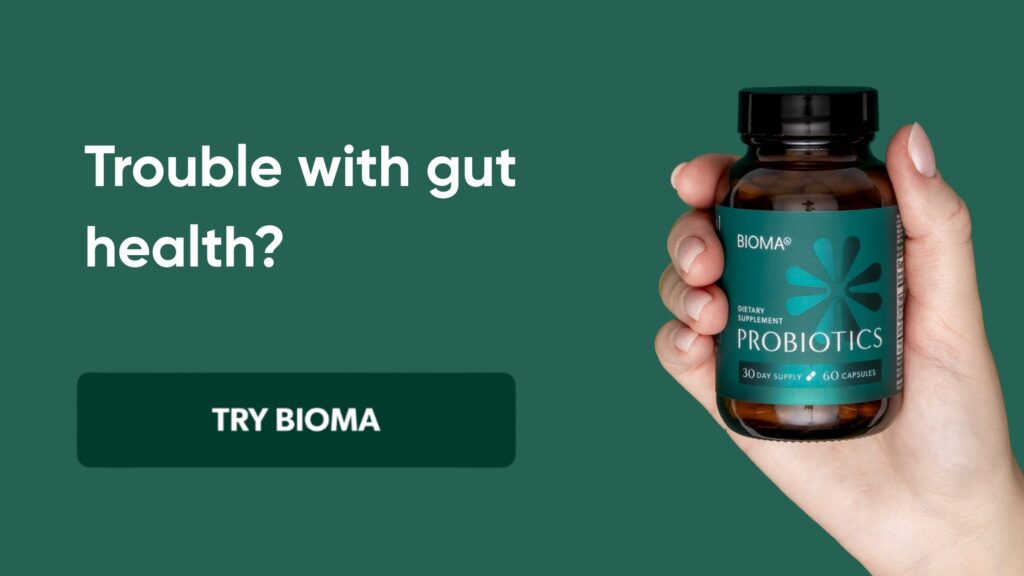
The formula also includes Xylooligosaccharides (iXOS™), a prebiotic fiber that helps beneficial bacteria thrive, and Tributyrin (Corebiome™), a butyrate precursor that supports gut lining integrity. Together, these ingredients are designed to promote a healthier gut environment, which may reduce inflammatory stress signals that influence mood and energy.
Bioma Probiotics are not mental health treatments, but by supporting digestive balance and microbial diversity, they align with research showing that improving gut health can be one piece of the broader mental wellness picture.
So… Can Probiotics Improve Your Mental Health?
Research shows that probiotics can contribute to better mental wellbeing, particularly through their impact on the gut–brain axis, inflammation regulation, and stress response balance. This suggests that supporting the microbiome is not just a trend, but a biologically grounded strategy.
Mental health is never one dimensional, but that does not mean individual systems do not matter. The gut plays a meaningful role in immune signaling, cortisol regulation, and emotional resilience. When microbial balance improves, the nervous system often becomes more stable as well.
Probiotics are not a standalone solution, but they are a powerful contributor. By supporting digestive health, reducing inflammatory stress, and strengthening the gut–brain connection, they can help create a more balanced internal environment. And for many people, that biological support translates into feeling more steady, more clear headed, and more emotionally resilient over time.
Related articles



Less gut discomfort. More freedom to enjoy life.
Take our 1-min quiz to find out your gut type and get personalized advice and probiotics to relieve constipation, bloating, and other digestive issues.


